
Construction loan draws release your home’s construction funds in stages as work is completed and verified, rather than as one lump sum at closing. Each payment connects the approved budget to documented progress.
For a Southwest Florida custom home, that connection affects contractor payments, interest charges, and scheduling. We recommend understanding the payment process before work begins, starting with who submits each request and what the lender needs.
Key Takeaways
- Draw approvals depend on completed work, supporting documents, and enough remaining funding to finish the home.
- Retainage commonly holds back 10%, although loan programs and agreements differ.
- Final funding usually requires completion records, lien documentation, and a certificate of occupancy.
How Construction Loan Draws Work
A payment application is the contractor’s bill to the owner. A draw request asks the lender to release loan funds. The payment application usually supports that request.
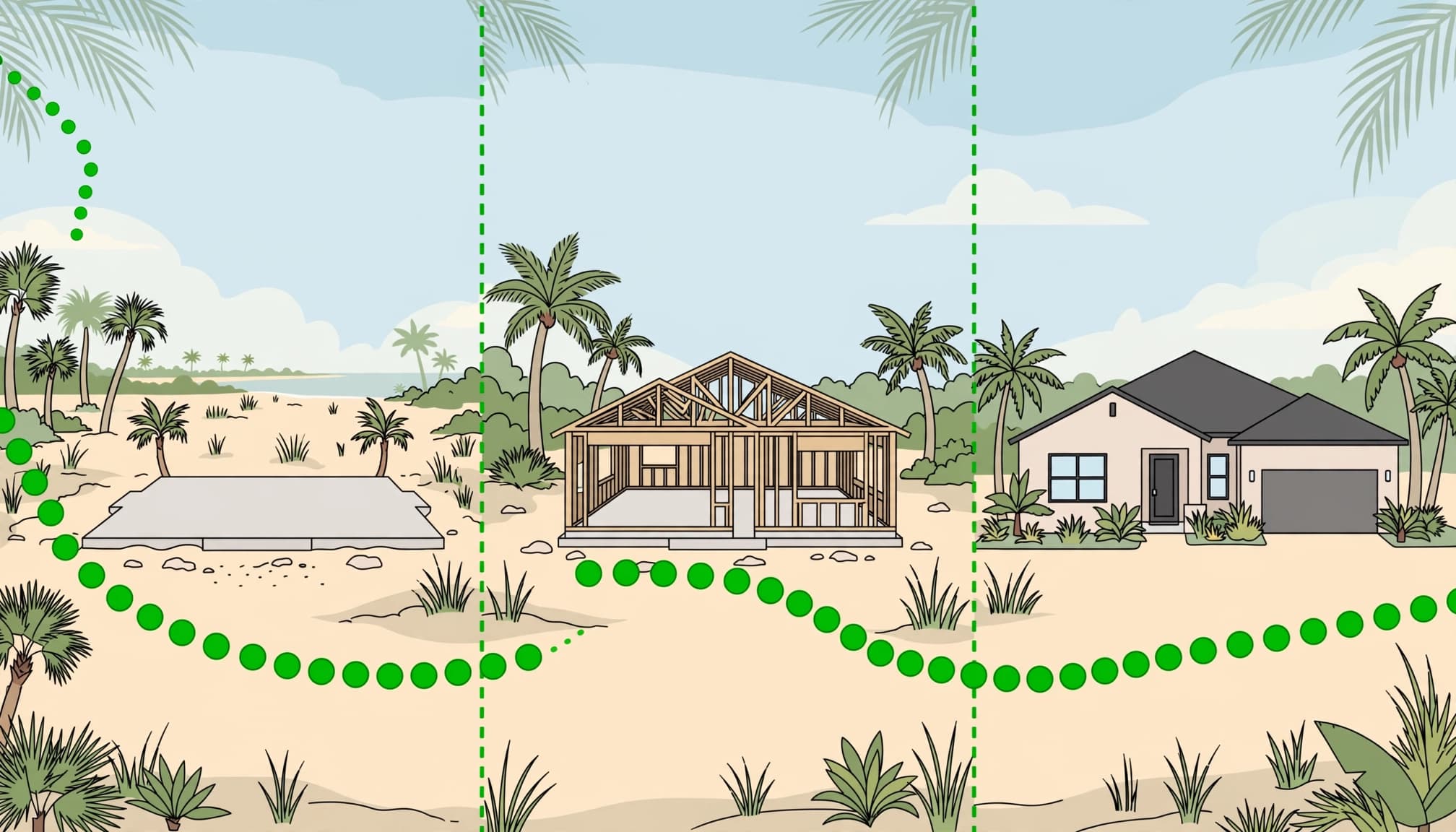
The cycle follows five steps:
- The borrower contributes equity according to the loan agreement. The agreement may require equity first or proportional contributions.
- The builder completes eligible work and bills against the approved construction budget.
- The borrower or authorized builder submits the draw request form and other paperwork required by the lender.
- The lender orders a draw inspection, and the inspector verifies completed work and the percent complete in the inspection report.
- The lender reviews the records, including lien documentation, then releases approved funds, less applicable retainage and other adjustments.
After payment, obtain the corresponding unconditional lien waivers for the next package.
Funds may go directly to the builder, through a controlled account, or by joint checks. The loan documents establish that arrangement.
The OCC’s construction-lending guidance says disbursements should match improvements completed as of the inspection or certification date. A scheduled payment date alone doesn’t establish eligibility.
A draw inspection measures progress for financing. It doesn’t replace municipal code inspections or a separate Florida pre-drywall inspection.
What Goes Into a Draw Package
Billing and Approved Changes
A typical package includes a pay application, invoices, and approved change orders. Many projects use AIA G702 and G703, although lenders may require their own forms.
G702 summarizes the payment request. G703 provides the supporting breakdown, commonly organized around a schedule of values, with billing tied to the percent complete for verified work.
We recommend keeping each change order connected to its revised budget line. An owner-approved upgrade doesn’t automatically become a lender-approved expense.
Payment Protection and Inspection Records
Lien waivers include conditional releases that accompany a requested payment and unconditional releases that confirm funds have been received.
The lender also needs an inspection report before approving release, although its inspector may provide that report separately.
Florida’s construction lien law can expose property to claims when subcontractors or suppliers remain unpaid, even after the owner pays the general contractor. Keep invoices, waivers, inspection records, and payment receipts together.
Draw Schedules and Retainage
Fixed Installments or Progress Payments
The construction draw schedule sets the milestones for each release, while the draw schedule identifies eligible work.
A standard payment plan uses fixed installments at designated construction stages. The OCC describes five equal installments as a common residential pattern, not a requirement for every custom home.
A progress payment plan pays for completed work less the holdback, generally through monthly requests. Larger commercial projects commonly use this approach; residential lenders also establish their own progress-based schedules.
In either plan, the agreed milestone or eligible completed work controls payment. A date on the calendar alone doesn’t make funds available.
How Much the Lender Holds Back
Retainage is the portion withheld until completion requirements are satisfied. A common arrangement holds back 10% from eligible payments.
The OCC describes holdbacks of 10% to 20% for progress-payment plans. FDIC guidance describes disbursing 90% of value and retaining 10%. These are lending practices, not a Florida-wide requirement.
Certain HUD-insured programs permit retainage to decrease to 5% after 50% completion and 2.5% after 75%. Those reductions depend on program conditions, including satisfactory performance and applicable surety consent. They aren’t automatic benefits of an ordinary residential construction loan.
A Worked Construction Draw Calculation
For illustration, consider $40,000 in newly completed, verified work under a loan with 10% retainage. Assume no other adjustments apply.
The payment calculation is straightforward:
| Draw Component | Amount |
|---|---|
| Newly verified eligible work | $40,000 |
| Retainage at 10% | $4,000 |
| Current payment released | $36,000 |
The builder receives $36,000, while $4,000 remains held back. That retained money still belongs to the project’s funding plan.
For cumulative pay applications, the calculation starts with total eligible work completed to date. The lender subtracts cumulative retainage and previous payments to determine the current amount due. This prevents paying twice for previously funded work.
The lender also applies a cost-to-complete test: undisbursed loan funds plus remaining committed owner equity must cover the remaining project costs.
A project can show satisfactory physical progress and still fail that test. Price increases, underestimated allowances, or upgrades may create a funding shortfall.
Before affected work proceeds, identify committed additional equity or get approval for a revised funding plan. Held-back funds and later draws don’t automatically cover a shortfall. Retainage isn’t spare money for additional finishes.
A detailed understanding of Fort Myers custom home costs also helps keep site work and allowances within the original budget.
Interest, Draw Fees, and Payment Timing
Interest and Interest Reserves
During construction, borrowers usually pay interest only on disbursed amounts. As construction loan draws increase the outstanding balance, the interest payment generally increases too.
Some loans include an interest reserve, a budget allocation that funds interest payments during construction. As the lender advances reserve funds, those advances increase the loan balance. The reserve doesn’t eliminate borrowing costs.
The FDIC’s interest-reserve guidance explains this funding structure. Delays can exhaust a reserve because interest continues while the home remains unfinished.
Fees and Review Time
Lenders may charge a draw fee, an inspection fee, or both. Reinspection and extension charges may also apply under the agreement.
Florida residential loan workflows vary, so there isn’t one dependable statewide turnaround deadline. Document review, inspector availability, title review, and corrections all affect release.
Before construction starts, establish the submission cutoff, time for document review and site verification, and payment timing after approval. One project contact should coordinate billing, inspections, approvals, and lender communication.
A quoted funding period should distinguish a submitted request from a complete, approved package.
Florida Conditions That Can Delay Funding
Flood insurance deserves early attention in Southwest Florida. For covered construction loans on buildings in a special flood hazard area, coverage must be in place before building-construction advances, subject to limited exceptions for preliminary work and materials.
The NFIP generally has a 30-day waiting period, although exceptions can apply when insurance relates to a loan closing. The interagency flood-insurance guidance explains the timing requirements. Arranging coverage late can interrupt an otherwise ready draw.
Other delays include missing waivers, unsigned changes, expired insurance, and billing that exceeds inspected progress. Stored materials may require separate approval and documentation.
If a lender rejects or partially funds a request, we recommend obtaining the line-item reason in writing. Separate missing paperwork from disputed progress and funding shortages.
Then submit corrected records, arrange reinspection when necessary, or document additional equity. Don’t carry a rejected charge into the next request without resolving its status.
Final Funding and Questions Before Construction
What Releases the Final Draw
The final draw requires a final inspection confirming completion and a certificate of occupancy, along with any other conditions in the loan documents. After the final inspection and certificate of occupancy requirements are met, reconcile allowances, change orders, retainage, and payment records, then deliver the required final unconditional lien waivers or releases before the lender releases the remaining funds.
Keep punch-list corrections separate from later warranty service.
A home that looks finished may still have open permit or payment requirements. We recommend beginning closeout planning before finish work ends so missing records don’t delay final funding.
The builder, borrower, and lender should coordinate payment and waiver delivery so releases accurately reflect payments received.
Questions for the Builder and Lender
Before signing, establish who manages each part of the funding process. These questions also support choosing a custom home builder:
- Who submits draw requests, and what makes a package complete?
- Does owner equity fund the project first, and how does lot equity count?
- What retainage, draw fees, inspection fees, and review periods apply?
- How do deposits, stored materials, and change orders qualify for funding?
- Who covers a shortfall, and which documents release final retainage?
Written answers help align the construction contract with the loan agreement.
Frequently Asked Questions
Does the Borrower Receive Every Draw Personally?
Not necessarily. The lender may pay the builder directly, use joint checks, or release funds through a controlled account. The borrower still needs payment records showing what each draw covered. We recommend keeping those records with the corresponding pay application and waivers.
Does the Construction Loan Automatically Become a Mortgage?
Construction-to-permanent loans generally convert after completion and satisfaction of the lender’s conditions. Construction-only loans require separate permanent financing. The CFPB’s construction-loan guide explains these structures. Conversion depends on the loan terms and completion requirements, not simply the final draw.
Build With a Clear Payment Plan
Construction loan draws work best when the budget, completed work, and payment records agree. Clear responsibilities help prevent missing paperwork and unresolved changes from interrupting construction.
We recommend establishing the funding process alongside your construction scope and schedule. Keep that same discipline through final inspection and retainage release.
For help planning your Southwest Florida custom home, Get In Touch with our team.