
An “impact-rated” listing doesn’t tell you whether a home’s windows meet the requirements for that property. Florida product approvals help verify the exact product, its permitted uses, and its installation requirements.
We recommend checking those details before you purchase a Southwest Florida home or finalize replacement windows and doors. The strongest protection is a documented match between the product, the approved plans, and the installation.
Start with the property’s jurisdiction, then follow the approval record through to the actual opening.
What Florida Product Approvals Actually Cover
A product approval establishes the conditions under which a building product can meet applicable code requirements and support building envelope integrity. It applies to defined models, configurations, sizes, and installation methods.
An approval for one manufacturer’s window series doesn’t cover everything that company sells. Different glass packages, frame types, door arrangements, and mounting conditions may have different limitations.
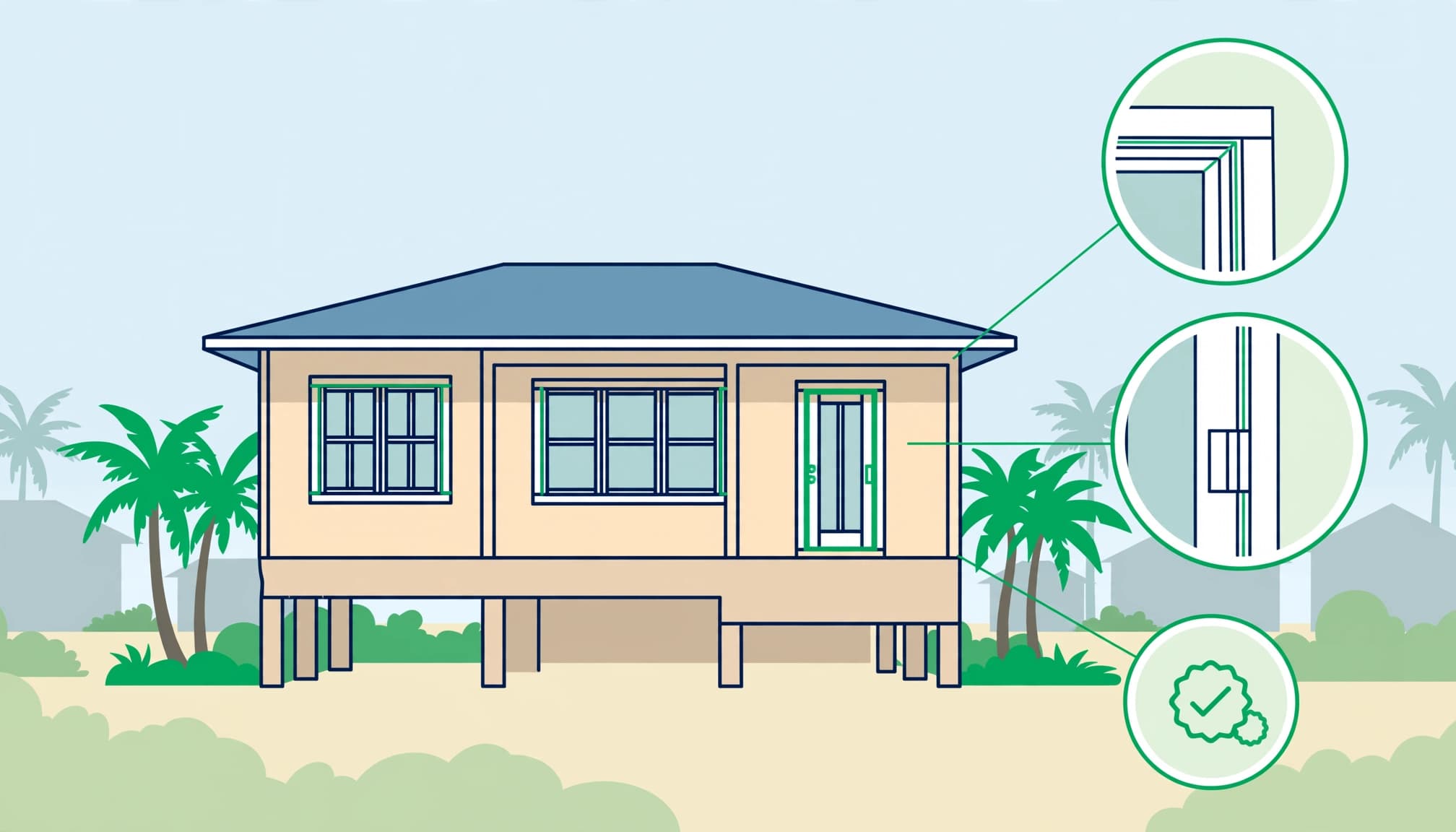
Rule 61G20-3.001 identifies eight categories within the state’s product approval framework: panel walls, exterior doors, roofing products, skylights, windows, shutters, structural components, and impact protective systems.
For homebuyers, exterior doors and windows deserve close attention because they help protect the building envelope. When present, skylights need their own review, and shutters require a separate record review of the hurricane shutter approval.
We treat an exterior selection as complete only after its appearance, cost, approval requirements, and installation conditions align. A showroom sample or sales brochure isn’t enough to establish that match.
Confirm the Jurisdiction and Code Edition
Start With the Property Address
Fort Myers, Cape Coral, Naples, Sanibel, and unincorporated county areas can have different permit procedures and documentation requirements. Confirm which city or county regulates the property before collecting forms.
The property’s location can determine whether it’s in a wind-borne debris region and which opening requirements apply. Your design professional should identify the wind-design requirements for the address and each opening.
Building height, exposure, and opening location can affect the required performance. There isn’t one wind-speed figure or window specification that fits every Southwest Florida lot.
HOA approval may also be required, but it doesn’t replace building-code review.
Match the Approval to the Permit’s Code
The Florida Building Code, 8th Edition (2023), took effect December 31, 2023. The Florida Building Commission’s official schedule lists December 31, 2026, as the adoption date for the 9th Edition (2026).
For projects near that transition, confirm the code edition governing your building permit application with the local permitting authority. Don’t select a database edition simply because it’s the newest available option.
The Miami-Dade product approval notices document code-related approval updates. For an existing home, review the permit-era records rather than assuming today’s approval documents establish what was installed years earlier.
Compare Statewide Approval and Miami-Dade NOA
A Florida Product Approval is recorded in the state system and identified by an FL number. A Miami-Dade NOA, or Miami-Dade Notice of Acceptance, is issued through county Product Control.
Both records require a close reading of the product’s scope. Neither document automatically substitutes for the other or authorizes every product configuration and installation.
For properties in Miami-Dade or Broward, confirm the applicable high-velocity hurricane zone requirements. HVHZ work may have additional acceptance requirements, so a statewide product approval isn’t automatically acceptable. A wind-borne debris region designation is broader and doesn’t by itself establish HVHZ requirements.
The Miami-Dade Product Control Search lets you locate NOAs and review supporting documents. Check the model, approval dates, limitations, and installation drawings.
Testing requirements are product-specific. The Sentinel 120 window NOA, for example, lists TAS 201-94, TAS 202-94, and TAS 203-94. Check the testing application standards and product scope in the actual NOA or supporting documents. This example doesn’t establish requirements for other windows or doors.
We recommend having the builder or design professional confirm the approval path accepted for your project. If a reviewer cites a local product approval requirement, ask which record is required and how it relates to the state approval or NOA. An NOA shouldn’t be assumed to automatically satisfy every statewide approval requirement.
Verify the Record in the DBPR Database
Search by FL Number or Manufacturer
Use the official Florida Product Approval database, the DBPR product approval search maintained through the state’s building-code system.
An FL number is the most direct starting point. If you don’t have it, search by product manufacturer, product category, and applicable code edition. Confirm the code edition against current information from the Florida Building Commission. The seller, supplier, or builder may have the FL number in the permit package.
Follow this sequence:
- Select the code edition that applies to the permit.
- Enter the FL number or available product details.
- Match the product manufacturer and model to the proposed or installed product.
- Review the current record status, revision, and individual product entries.
- Open and save the evaluation documents and installation instructions.
Read the Attachments, Not Just the Result
The search result is the starting point. The attachments contain the conditions that determine whether the product fits your project.
Look for the exact product entry or sub-number, where applicable. Review limitations, impact classification, testing application standards, sizes, maximum tested size, pressures, supporting drawings, and mounting details.

Keep the approval record and its attachments together. A screenshot showing an FL number won’t provide the full information needed for plan review or installation.
If the database record conflicts with supplier documents, pause and resolve the mismatch with the responsible professional before ordering.
Match Size, Pressure, and Installation Details
Compare Both Pressure Directions and Approved Sizes
A product’s design pressure rating describes the loading it can resist under approved conditions. Positive pressure pushes inward; negative pressure pulls outward.
Compare the product’s positive and negative design pressure ratings with the required pressures for each opening. A higher positive rating doesn’t make up for an inadequate negative rating.
Approved dimensions matter equally. A window that performs adequately at one size may have different limits at another size. The selected unit must fall within the approval’s size limits, including its maximum tested size.
These are the main comparisons your design team should make:
| Approval Detail | Compare It With |
|---|---|
| Positive and negative design pressures | Required pressures for the opening |
| Approved width and height | The selected unit’s dimensions |
| Glass and frame configuration | The exact ordered product |
| Mullion or combined-unit limits | The complete opening arrangement |
| Impact classification | Required opening protection |
We recommend reviewing the complete assembly. In combined openings, the window and mullion ratings can differ; the controlling limitation must be identified.
Check Anchorage and the Supporting Wall
Installation instructions identify fasteners, spacing, embedment, edge distances, and acceptable substrates. Concrete, masonry, and wood-framed conditions aren’t interchangeable.
An approved product can still be installed incorrectly if the installation instructions, anchors, or supporting wall don’t match the documented conditions. Opening changes may require structural review, including the header and surrounding framing.
Our structural wood framing services address the supporting construction when wood-framed openings need work.
Flashing, sealants, and drainage also deserve attention. Wind resistance doesn’t resolve every water-intrusion concern. Confirm that opening protection meets the property’s applicable design criteria, including any requirements for a wind-borne debris region.
Check Product Labels and Existing-Home Records
A permanent product label can help identify an installed window or door and compare it with its approval record. Photograph accessible labels and check the manufacturer and model information.
Label requirements vary by approval and product. For example, the Sentinel 120 Miami-Dade NOA requires manufacturer identification, city and state, model or series information, and a Miami-Dade Product Control approval statement, unless otherwise specified.
Don’t apply that example as a universal statewide label format. Read the requirements for the exact product.
For a home purchase, check records from the permit era against the property’s applicable requirements in a wind-borne debris region. Request window and door permits, approved product schedules, inspection records, invoices, and installation instructions. Ask whether replacements were installed throughout the home or only in selected openings.
An approval record establishes a product’s permitted use. It doesn’t prove that every window in an existing home is that product or was installed according to the approved documents.
Missing labels or records require further investigation. They don’t establish compliance, and they don’t automatically prove noncompliance.
Our Florida renovation and resale guide also addresses property review before renovation. Keep product verification alongside the broader assessment of roof condition, moisture, structural work, and permit history.
Handle Evaluation Reports and Product Changes
Understand What Supporting Reports Can Establish
Some approval applications rely on an architect’s or engineer’s evaluation report or test report. The DBPR product approval guidance explains recognized application pathways, and the Florida Building Commission provides current official guidance.
Technical evaluation reports or Master Plan Sheets may provide supporting technical information. A product evaluation report isn’t automatically a replacement for an FPA, NOA, or project-specific review. Check how its findings relate to the applicable testing application standards.
When a proposed installation falls outside standard documents, ask the design professional and permitting authority whether technical evaluation reports provide sufficient evidence and what additional approvals are required. Resolve that question before committing to the product.
Document Substitutions Before Installation
A replacement product may alter approved dimensions, anchorage, glass specifications, or pressure ratings. Confirm its dimensions stay within the maximum tested size, since a similar appearance doesn’t establish equivalent performance.
Check the installation instructions, update the product schedule, and obtain any required permit revision before installation. Confirm the revised selection with the supplier, builder, and affected trades.
We recommend maintaining one current window and door schedule. Record the opening identifier, manufacturer, model, dimensions, approval number, finish, and document revision. This keeps selections coordinated and reduces incorrect orders or avoidable changes.
For planned replacements, our Southwest Florida remodeling services can support early scope review and construction coordination.
Key Takeaways Before Purchase or Permit Submission
The final review should leave you with a usable record, not a folder of unrelated brochures.
Before you approve an order or complete your purchase review:
- Keep the exact approval record, supporting drawings, and installation instructions with the window and door schedule to support code compliance.
- Confirm who is responsible for checking specifications, answering permit corrections, coordinating inspections, and documenting substitutions.
- Resolve missing identification, conflicting revisions, or unsupported installation conditions with the appropriate professional.
Save final permit and inspection records after the work closes. Those documents can help with future repairs, replacement parts, resale questions, and insurance discussions.
Frequently Asked Questions
Does an impact-rated window fit any Florida home?
No. Impact classification is only one part of the review. The window must also meet the opening’s required pressures, approved dimensions, configuration, and installation conditions.
We recommend checking the complete approval rather than relying on an impact-rated description in a listing or estimate.
Can an FL Number Prove Existing Windows Were Installed Correctly?
No. The number identifies an approval record. Verification still requires matching that record to the installed product and reviewing available installation and permit documentation.
If the records are incomplete, ask a qualified professional to assess what can be confirmed and what needs further investigation.
Build Confidence Through Complete Verification
Florida product approvals are most useful when the documents match the product, the property requirements, and the installation. That complete match provides a stronger basis for decisions than a sales description alone.
We recommend resolving discrepancies before ordering replacements or relying on a home’s advertised storm protection.
For help planning a Southwest Florida build, remodel, or window and door replacement project, Get In Touch with our team. We’ll help coordinate the construction scope and documentation your project requires.